1,200 pages. Full internal linking. Basically no traffic.
A backend developer posted that inventory to Hacker News in April 2026: an AI-built utility site, about 1,200 static pages, zero backlinks, partial indexing. The comments did not argue about the build. Nobody argues about the build anymore.
No account. Scores are computed from the inputs you supply. Not a forecast of traffic or revenue.
Six of the thirteen layer contracts, L00 intake through L12 monitor. Nothing on this page animates and nothing here is a recording of a run.
Nothing between the keyword and the deploy can tell you no
Even the one-star reviews of the AI site builders concede the build before they deliver the verdict. "Easy to build a website and I'll give them that," writes one reviewer, and then: "it will still be invisible on search". An operator who ran 225 templated pages for four weeks posted the arithmetic in March 2026: 6,220 impressions, 7 clicks, and his own diagnosis, "Google appears to detect repeated template structure across pages".
Build speed was never the constraint. The defect sits upstream of the build, and it has a shape.
You hand a coding agent a keyword on Friday. It says yes. Yes to the niche, yes to the domain, yes to page 400. The documented failure modes of these agents all run in one direction, rewritten working code, hallucinated functions, runaway loops, and none of those reports describe the agent stopping a run. Your acceptance criteria live in a CLAUDE.md file and a checklist you wired up yourself, the workaround this audience keeps rebuilding by hand, and they evaporate between sessions. So by Sunday you own a deployed site, and the first honest verdict on the whole project arrives weeks later, in Search Console, as a zero. That is the entire defect.
The missing part is a machine that says no
A layer in this pipeline is not a prompt, it is a contract, and the contract is enforced: 395 machine-evaluable gates sit across the 13 build layers and 7 growth stages, 363 of them blocking, counted from the repository's 20 gates.json files on 2026-08-07. A blocking gate that fails halts the run. A blocking gate that cannot be evaluated also halts the run, because SKIP fails closed and "could not check" is not "fine". An unknown value propagates as null instead of acquiring a flattering default, and a score computed on partial evidence prints its own coverage fraction next to itself. That is the mechanism, and it has a name you can hold me to: the refusal engine.
- artifact
- one JSON per layer, atomic write
- layer gates
- 204, of which 182 blocking
- sprint gates
- 191 across 7 stages, 181 blocking
- assertions
- 157 in use, every one implemented
- on re-run
- downstream artifacts invalidated, not deleted
- unknown values
- propagate as null, never as a default
Four sites I run, and the Search Console data behind them
Operator record, not pipeline outputThis pipeline did not build these four sites. I built them with earlier tooling of my own, before this pipeline existed, and no site has been taken from intake to indexation by it. That is stated in the FAQ and in the terms, and it is stated here too, next to the numbers, because a results section that lets you assume otherwise is the fabrication this whole product argues against.
What the table is, then. Four live sites, each one linked below, with the Google Search Console export for each downloadable as the raw CSV bundle Google itself emits. The numbers were computed from those files, not typed in by hand. Read them the way you would read any operator's track record, which is the reason the layer contracts say what they say and the only reason this section is on the page.
One of the four is barely working. goldgramprice.com has 6,531 impressions and 2 clicks. It is indexed, it is being shown, and it is not yet being clicked. It's in this table for the same reason the others are: a results section that only contains winners is not evidence, it is selection.
| Site | Clicks | Impressions | CTR | Days | Pages |
|---|---|---|---|---|---|
| ingredientcalculator.com | 240 | 17,673 | 1.36% | 86 | 26 |
| lakelevelnow.com | 106 | 14,410 | 0.74% | 39 | 73 |
| ml0x.com | 14 | 1,399 | 1.00% | 91 | 36 |
| goldgramprice.com | 2 | 6,531 | 0.03% | 40 | 33 |
Totals across the four sites, computed from their Google Search Console exports: 362 clicks and 40,013 impressions. Each window is that property's own Search Console range ending 2026-07-29, so the windows differ and the totals are a sum across four different periods rather than a like-for-like comparison. Position is not averaged here because averaging a position across properties produces a number that describes nothing.
What they look like
Live, click through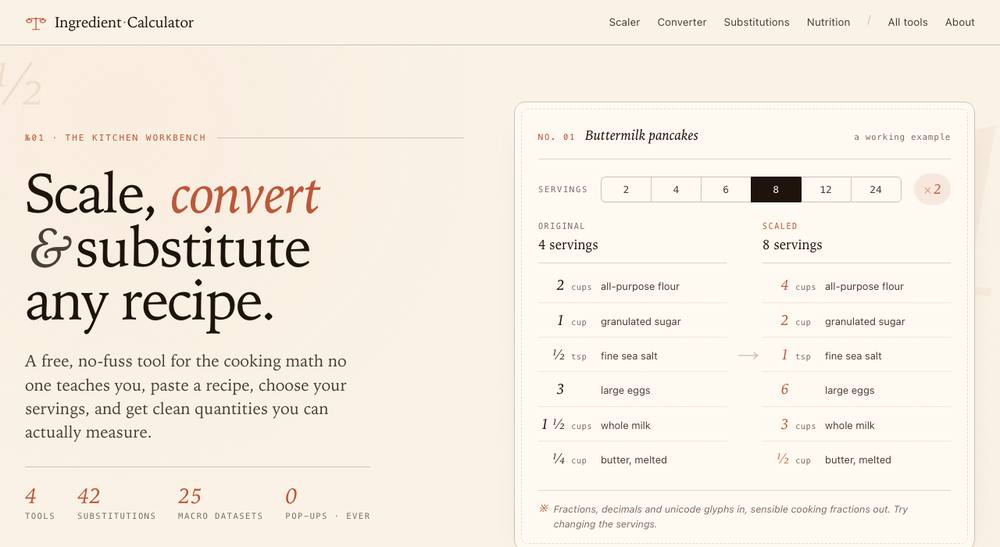
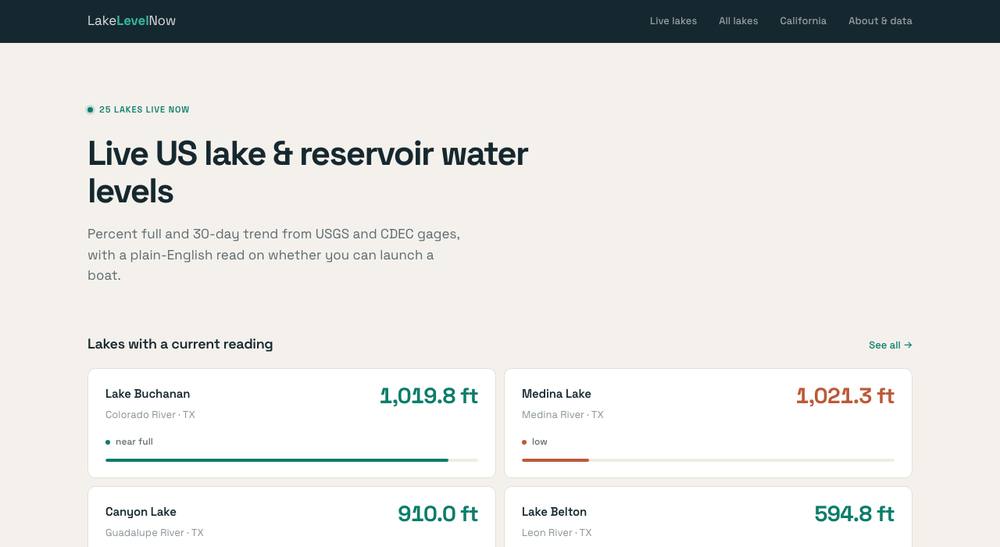
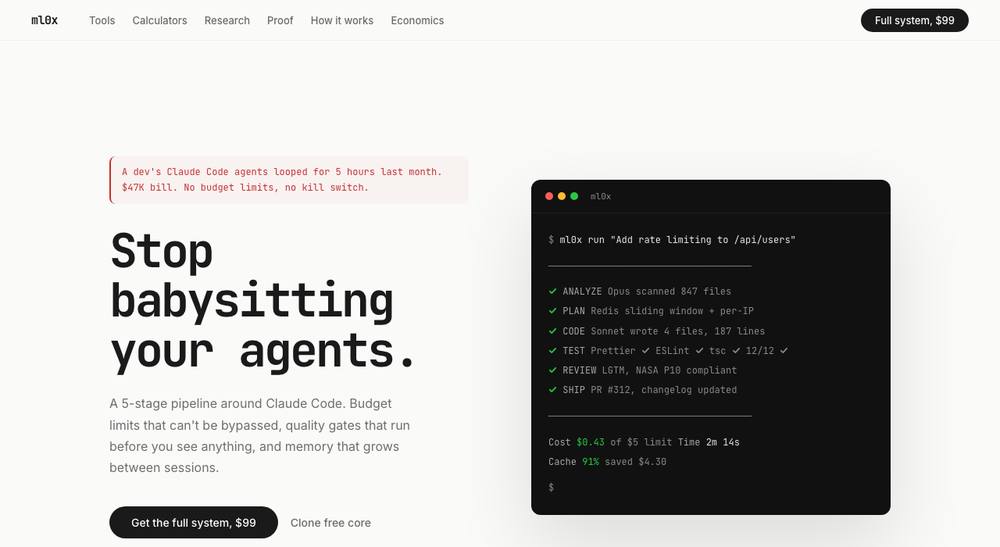

Four different visual systems, on purpose. A pipeline that emits one template with different colours gives every site it produces the same fingerprint, and a pattern-level action then hits all of them in the same week. Template diversity is a gated output, not a preference.
Download the raw data
Unedited GSC exportEach bundle is the export Search Console produces: daily chart, queries, pages, countries, devices, and the filter set that produced it. Nothing was removed or reordered. Recompute the table above from these files and you should get the same numbers.
What this section is not. It is not a forecast, it is four measured properties over their own windows. It is not a base rate, because four is not a sample. It is not a claim about what a fifth site would do, and it is not evidence that this pipeline produces sites like these, because it did not produce these. Search Console reports what Google chose to show and chose to count, and nothing here promises traffic, rankings or indexation for any site you build.
Compare the failure column first
Fetched 2026-08-07The row that runs against this product comes first: zero customers, zero completed end-to-end runs, zero testimonials. Every alternative below has shipped more production output than this repository has. None of them ships a quality floor: across all four landing pages, fetched 2026-08-07, there is not one mention of blocking gates, acceptance criteria, or verification as part of the offer. That absence is the column that decides this comparison.
| Alternative | Price over 12 months | What happens on failure | Refund and exit |
|---|---|---|---|
| ShipFast, Next.js SaaS boilerplate | $199 once, Starter tier | No gate system; it sells starter code, and what ships on top of it goes unjudged | "it can't be refunded" once the repo is delivered, per its own page. You keep the repo. |
| Durable, hosted AI builder | $25/mo, $300 over a year | Generates in a claimed 30 seconds; no verification layer offered | Its 1-star reviews allege domain-transfer stalling and continued billing after leaving |
| Mixo, hosted AI builder | from about $6/mo | Generates in a claimed 60 seconds; no verification layer offered | Charged-after-cancel and unable-to-close-account complaints are a dominant 1-star theme for subscription builders |
| SEObot, autonomous SEO articles | $49/mo, $588 over a year | Its own landing page concedes "article quality varies"; you become the QA gate you paid to remove | Priced monthly for as long as you stay |
| Raw Claude Code, no gate system | $0 beyond what you already pay | Nothing stops the ship: no definition of done exists, and the documented failure modes, rewritten working code, hallucinated functions, runaway loops, pass in silence | Nothing to exit. Everything is already yours. |
| This repository | $199 once, nothing recurring | 363 blocking gates halt the run; a gate that cannot be evaluated halts it too | Sixty days, full refund, no reason needed; after that, refundable if the software is not as described, never contingent on rankings. Perpetual license, unlimited own and client sites. |
Competitor prices and quoted policies were read from the live pages on 2026-08-07. The annualized figures are that arithmetic and nothing more.
One row needs its apples named. ShipFast is the same sticker price for a different job: it sells SaaS starter code with auth and payments pre-wired, it includes lifetime updates where this repository promises none, and it has survived a public security-bug controversy and a public apology in that role. This repository sells no auth and no payments. It sells the judgement layer for keyword-driven static sites built by an agent you already run. The overlap is the buyer and the $199, not the product. What the identical price makes comparable is the recourse: their page states the purchase cannot be refunded, this one gives you sixty days without a reason.
One axis is missing from the table: whose numbers you can check. The category proves itself with counters: 10M+ sites built, 750k+ businesses, a live ticker of makers beside the price card. You already discount those numbers, which is why buyers in this market append reddit to their searches to route around vendor pages entirely. This page holds the opposite inventory: measured counts you can re-run, a published FAIL verdict, and a plain statement that no customer result exists yet. Small numbers with receipts are the only proof here. They are also the only kind you can check.
The exit, stated plainly: raw Claude Code plus your own discipline is the strongest alternative in this table, it costs nothing more than you pay now, and for one site run by a careful operator it may genuinely be enough. What it cannot do is refuse. A checklist held in your head does not halt a run, does not survive to the next session, and does not fail closed when a check cannot execute, which is exactly how the documented failure modes ship. Five alternatives sell generation. This one sells the part that says no.
The demo that fails is the proof
State of the productStart with what does not exist. No end-to-end run of this pipeline has ever been completed, by anyone, including the developer who wrote it. No demo site exists. The count of customers, reviews, and outcome numbers is zero on every axis, counted against the live Stripe account on 2026-08-07. Any testimonial you ever see for this product is fabricated, and the page tells you that before you pay. You would be the first buyer to take a site from intake to deploy. That sentence is doing more work than any claim below it.
What does exist can be counted from your own shell. The archive is 1,218,426 bytes, and its SHA-256 is printed on the delivery page. ./verify.sh runs 14 checks and 546 tests, no network, no API key, and exited 0 on the tree as shipped when last run on 2026-08-07. The domain engine has run against the live .com registry: 6,135 candidates checked over RDAP on 2026-07-30 and 31, of which 2,369 available, 3,766 registered, 0 left unknown, published with its method and its sample bias stated. Every count in this section carries the command that reproduces it. Rerun the commands rather than take the section's word.
Then the part a results section is supposed to hide. The gate suite fails the seller's own demo. The L03 demo run reports 9 PASS, 1 WARN, 2 FAIL, because the trademark and prior-use screens are not built yet, and in this pipeline a blocking gate that fails, or cannot be evaluated at all, halts the run instead of passing it. No domain gets recommended on evidence that was never gathered. A results section that only contains passes is not evidence, it is selection, and those two FAILs are the product working.
The same machinery is what stands between you and the output this category is hated for. Buyers of AI site builders describe what they got, in their own reviews, as "a cookie cutter-website that is nothing more than a brochure". Here, 395 machine-evaluable gates, 363 of them blocking, each with a written rationale, judge what the model generates, and an unknown propagates as null rather than as a flattering default. None of that proves your site will be good. It proves that when it is not, something written down will say so.
That is the full proof inventory: counts you can rerun, one live-registry dataset, and a demo published at FAIL. None of it proves a site you build ranks, gets indexed, or earns a click, and nothing on this page will ever claim otherwise. What it proves is narrow: the repository described here exists, runs, and refuses to flatter itself. The guarantee below is written against exactly that claim, and no other.
You have seen the data, here is the offer
One paymentOne repository. Thirteen layer contracts, seven growth stages, 395 gates, a working CLI and domain engine, and four design prompts. 57,205 lines, and you can read every one of them before you pay.
Sixty days, full refund, no reason needed, one email. After that, refunds turn on whether the software is what this page says it is and runs as specified. Never on whether a site ranked.
Who built this
Verifiable, not assertedThis pipeline was built by Michael Lip, a solo developer with 1,081 public repositories on GitHub since 2019 and 75 pull requests merged into 66 repositories he does not own, among them PrefectHQ/prefect, HeyPuter/puter and Google's own chrome-extensions-samples. Both figures were counted on 2026-08-15 with the GitHub search API and both move on their own. The search that produces them is linked below, so you can rerun it rather than take the number.
One person wrote the layer contracts, the gate suite, the CLI and the agent prompts. That cuts both ways. There's no team behind this, and there's nobody between you and the person who wrote it either.
Those two figures come from Search Console for belikenative.com covering 30 Mar 2025 through 28 Jul 2026, shown at the rounding Search Console itself displays. Read them as the operator track record and nothing wider. belikenative.com runs on WordPress and this pipeline was not used to build it, so none of that traffic is pipeline output. It sits here because the judgement written into the layer contracts came from running sites like that one, not because the pipeline produced the number. The same applies to the four Search Console exports further up this page. Download them and recompute them, but read them as operator record. There is no pipeline output to show, because no end-to-end run has been completed.
Extension figures are the Chrome Web Store counts as of 2026-07-31 and move on their own. Check the listing rather than trusting this page. 87 Chrome extensions have shipped in total, carrying 87,500+ users between them as recorded on 2026-08-14; BeLikeNative is the largest.
What those four numbers prove is narrow. They prove the person who wrote this ships software that thousands of people choose to keep installed, and that code of his has been accepted into projects with a far higher bar than his own. None of it proves that this pipeline will get your site traffic. Different claim, and only the first one is evidenced here.
The repository grades itself
It ships a script that reports its own state and exits non-zero if the tree is inconsistent. Here is the entire output, unedited.
AI Website Pipeline - state report
------------------------------------------------------------------------
[1] Python modules compile
    OK  18 modules
[2] Layer contracts present
    13 layers, 0 missing files
[3] gates.json parse + gate count
    204 gates (182 blocking), 0 parse failures
[4] Assertion coverage
    OK  every assertion in use is implemented
[5] Contract validation (awp doctor)
    Errors: 0   Warnings: 0
[6] Vendored design prompts
    4 prompt files
[7] Domain engine (offline: generation + filter + scoring)
    288 raw, 282 kept, 6 rejected
    top: coffeegrinder.com score=0.846 coverage=0.70 unscreened=tm_clear,history_clean
    coverage below 1.0 is expected: trademark and history are unscreened here
[8] Sprint track (GEO growth)
    7 stages, 0 missing files
    191 sprint gates, 0 parse failures, 0 contract problems
[9] Fleet keyword registry
    0 claims (0 active), 0 cross-domain conflicts
[10] Sales assets
    index.html present, 0 external references (must be 0)
[11] NASA Power of 10 audit
    OK  no build-failing violations (rules 1, 4, 7, 8, 9)
    rule 5   540 functions, 987 checks, mean 1.83 checks per function
[12] Regression suite
    OK  Ran 546 tests
[13] Gate/schema cross-check
    OK  no gate contradicts its own schema
    MISMATCH=15  NOTE=48
[14] External dependencies (informational)
    OK  every declared external input is present
------------------------------------------------------------------------
State: consistent and complete.
Network checks (live RDAP) are not run here. Use: ./awp domains <run_id>
Measured 2026-07-31. The script prints the repository's internal name, which is AI Website Pipeline; the product sold on this page is that repository. Scroll the block horizontally on a narrow screen.
Check 10 is not decoration. The script verifies that the sales page contains zero external network references, because a page selling a pipeline that vendors away third party dependencies should not itself load a font from someone else's server. This page loads no CDN, no third-party script, no iframe and no third-party analytics, and both typefaces are served from this origin. It sends exactly one kind of outbound request, to a Cloudflare Worker of mine, counting that the page was opened and whether the checkout link was clicked, with no cookie and no identifier attached. Everything else it renders comes from its own bytes.
Check 13 is on the page for the same reason. It reports fifteen mismatches between a gate and the schema of the stage it belongs to. A mismatch is not a contradiction, and no gate here contradicts its own schema, which is why the check passes. But it is fifteen places where one of the two is out of date, and printing that number is cheaper than pretending it is zero.
What the headline looks like in a terminal
The domain vetting layer, evaluated against a real artifact produced by a real query to the .com registry. Nine gates pass. Read gate 04.
L03-domain-vetting  gate evaluation
------------------------------------------------------------------------
  PASS  G-L03-01  len(shortlist)=10 min=3
  PASS  G-L03-02  all 10 items have availability.availability_source='rdap' (0 exempted)
  PASS  G-L03-03  all 10 items have availability.rdap_status_code=404 (0 exempted)
  FAIL  G-L03-04  20 of 20 flags are absent; cannot prove none are true:
            ['#0.trademark.tm_disqualified', '#0.history.hist_disqualified',
             '#1.trademark.tm_disqualified', ...] +15 more
  PASS  G-L03-05  sum(weights)=1.0000000000000002 over 7 values, target=1,
            |delta|=2.22e-16 <= tol 1e-09
  PASS  G-L03-06  all 200 values across 40 items within [0, 1];
            80 null and permitted
  PASS  G-L03-07  shortlist.0.score=80.49 min=70
  WARN  G-L03-08  40/40=1.000 of evaluated match (op='ne' value='checked'), max=0.3
  PASS  G-L03-09  0 of 10 values across 10 items are null
  PASS  G-L03-10  network.rdap_calls=40 max=400
  PASS  G-L03-11  10 items correctly ordered by score desc, length asc, sld asc
  FAIL  G-L03-12  2 of 5 fields are absent or empty:
            ['provenance.tm_source', 'provenance.wayback_endpoints']
------------------------------------------------------------------------
Schema:  OK (jsonschema)
Verdict: FAIL
Real output, run 2026-07-31 against the artifact on disk. Long detail lines are wrapped here for width; nothing is otherwise altered.
Twenty absent flags, and the gate refuses to assume they are clean
G-L03-04 fails with the words "cannot prove none are true". Trademark and prior use screening were not run for this shortlist, so the disqualification flags are absent rather than false. A permissive engine treats an absent flag as a clean one and reports a pass. This one states the count, names the missing fields, and fails the layer.
That single line is the entire product. Nine of twelve gates passed, the domains are genuinely available, the scoring is genuinely correct, and the verdict is still FAIL, so the layer does not advance and no domain gets recommended for purchase on evidence that was never gathered.
Three more lines are worth reading. G-L03-06 reports "80 null and permitted": unknown values propagate as null instead of acquiring a flattering default, and the gate knows which nulls are legitimate. G-L03-05 checks that a weight vector sums to one and reports a floating point delta of 2.22e-16 against a declared tolerance, because "the weights look about right" is not a check. And the last line before the verdict names the validator that ran, because a weaker fallback validator must never be mistaken for the full one.
Exactly what 199 USD buys
Counted 2026-07-31395machine-evaluable gates
204 across the layers (182 of them blocking) and 191 across the sprint stages (181 blocking), in 20 machine-readable gates.json files. Every gate carries a stable id and a written rationale showing the arithmetic behind its threshold. One repository, one payment, yours permanently.
L00 intake through L12 monitor, 14,305 lines of layer specification. Each layer declares its reads, its single output artifact, its algorithm, its execution class, its JSON Schema, and its failure modes.
The recurring post-launch track, kept separate from the build layers because it repeats. It carries 191 of the 395 gates.
Every assertion name used by any gate is implemented and evaluable, and awp doctor reports 0 errors and 0 warnings. A further 25 are registered but unused, for 182 in the engine. A layer may not invent an assertion without adding it to the library.
17 commands, 12,749 lines of Python across 18 modules, standard library only. A run state machine with atomic writes, automatic downstream invalidation on re-run, an append-only decision log, and a fleet-wide keyword registry.
6 generation strategies, a 9 stage canonical filter that kills candidates locally before they cost a network call, live RDAP .com verification with rate limiting, caching and a real unknown state, and composite scoring with evidence coverage renormalization.
1,404 lines, fixed files rather than something improvised each run: design, then a ten dimension validator that serves as the acceptance rubric, then responsive and SEO, then an optional brand kit. These prompts produced the page you are reading.
Run by ./run_tests.sh and again as check 12 of the 14 check state report. They cover the gate engine, both assertion libraries, the state machine, the name generator and scorer, the sprint interlocks, and the fleet registry.
Layer contract, sprint contract, GEO sprint guide, design workflow, an operating manual with realistic per-layer elapsed times, a NASA Power of 10 compliance record, and a commercial analysis written adversarially against its own premise.
Specification, prompts, code, tests, and documentation, counted by the command printed below. Not included: the domain, hosting, model API credits, keyword or SERP data, a Claude subscription, and any support commitment.
You could rebuild the visible surface of this in a weekend, and the repository says so in its own defensibility section. What a weekend does not produce is the part that gets bought: 395 gate rationales, 363 of them blocking, each one a written argument for why a check exists and what failing it means. That is weeks of unpaid specification work, and it is the difference between a model that does whatever you ask and a run that can tell you no. Build speed was never the constraint.
ShipFast sells repository ownership at the same 199 USD and says plainly that it cannot be refunded (shipfa.st, fetched 2026-08-07). This one refunds for sixty days, and ./verify.sh settles whether you got what this page describes before the window is a day old. That is the price to beat, and the refund window is the part it does not match.
0 USD
Already published. No account, no email, nothing to cancel.
- The method page, 13 layer contracts in build order
- The niche score calculator, L01 weights printed rather than hidden
- Two measured datasets, 6,135 RDAP checks and 35 sites of click yield
Read it all before you decide anything.
199 USD
One time. That is the total at checkout, and your card statement reads AUTOM8 LLC.
- Everything in the free tier, plus
- 13 layer contracts, L00 intake through L12 monitor, 14,305 lines
- 395 machine-evaluable gates, 363 of them blocking
- 7 GEO sprint stages carrying 191 of those gates
- A 17-command CLI, 18 Python modules, standard library only
- A domain engine with live RDAP .com verification
- 546 regression tests and a 14-check state report
- Unlimited sites of your own and unlimited client sites, permanently
Sixty day refund, any reason or none. The download link is on the next page, not in an email.
499 USD
One time. Adds seller time and takes nothing away from the tier beside it.
- Everything in the pipeline, plus
- A niche screen before you commit, scored on the L01 vector
- A written review of your first built site against the layer gates
- Three business days from the day you send the URL
- One reader, and it is the person who wrote the gates
The automatic download is wired to the 199 USD checkout only. At 499 USD your download link arrives by email within one business day rather than instantly, and the same reply books the niche screen. Sixty day refund either way.
Read the spec if you want to judge the method before spending anything. Take the pipeline if you intend to build. Take the review tier only if you want a second reader on your first niche and your first site, which most buyers do not need.
Nobody has deployed a site with this yet. A buyer goes first. The sixty days exist for that reason, and no refund request is audited for its motive.
Taxes are added at checkout where they apply. Stripe confirms payment and the next page holds the download link, served by a worker that checks your session against Stripe before releasing the file. No subscription starts and no account is created.
Compare the three tiers side by side, or read the FAQ first.
Your first ten minutes
Before you spend a tokenNothing here needs an API key, an account or a network call. You can audit the whole thing on your own machine first, and the pipeline is built so the checks come before the spending.
# does the tree hold together, and does every layer contract validate
./verify.sh
./awp doctor

# what you actually bought, listed with its class and gate count
./awp layers

# where a real run would stop, and which credentials it would need
./awp preflight

# the domain engine, offline: generate, filter and score without a network call
./awp domains --terms "espresso machine,coffee grinder"
Those five commands run against the repository as shipped. The first two are the same checks this page publishes its output from, so you can confirm the numbers on this page before you trust anything else on it.
Reproduce this page
Every number above came from one of these commands. The repository is the authority: if a command disagrees with this page, the page is stale and the repository is right.
# the state report, all 14 checks
./verify.sh

# layers, execution class, and gate counts per layer
./awp layers

# every assertion name in use, and whether it is implemented
./awp assertions

# contract validation across all 13 layers
./awp doctor

# gates that disagree with the schema of their own stage
./awp crosscheck

# the regression suite on its own
./run_tests.sh

# the live domain engine, then its gates
./awp domains demo --terms "espresso machine,coffee grinder,barista" --limit 40
./awp gate L03 demo

# the line counts quoted in the manifest
wc -l layers/*/LAYER.md layers/*/agent.md
wc -l sprints/*/LAYER.md sprints/*/agent.md
wc -l core/*.py tests/*.py tools/*.py docs/*.md
wc -l layers/L06-design-handoff/prompts/*.md

# the 57,205 line total, in one command
cat layers/*/LAYER.md layers/*/agent.md \
    sprints/*/LAYER.md sprints/*/agent.md \
    sprints/SOURCE-seo-geo-sprint-goal5-final.md \
    core/*.py tests/*.py tools/*.py docs/*.md \
    layers/L06-design-handoff/prompts/*.md | wc -l
Live registry results vary by run: availability changes, so the exact split of available and registered domains will not match a previous run. The raw and filtered candidate counts are deterministic and will. Re-running ./awp domains demo overwrites the demo artifact, so the gate output will then describe your run rather than the one shown above.
What this does not do
Required readingEvery item is drawn from the risk register in the repository's own commercial analysis, or from its status file. None of it is softened here, and none of it is softened there.
- NOIt does not produce a single backlink. The pipeline generates zero off-site signal. Nothing in layers 0 through 12 touches the demand side.
- NOIt cannot force indexation. Submitting a sitemap is a request, not an instruction. Google indexes a subset of what it crawls and offers no mechanism to compel inclusion. A technically flawless site can sit at partial or zero coverage indefinitely. Layer 11 reports measured Search Console coverage and nothing else.
- NOIt promises no traffic and no rankings. The repository states its own most likely failure plainly: you get a technically correct site, and day 90 arrives with almost no clicks, because ranking is limited by authority and external signal and this produces neither. Build speed was never the constraint.
- NOIt does not remove the human hour. Layer 6 needs you at claude.ai/design, iterating, for one to four hours per site, and the operating manual calls that a planning estimate and labels it as one. It's manual by construction. Buying it won't make it automatic.
- NOIt does not include a domain. You buy the .com yourself, and you buy it at layer 3, before the keyword map at layer 4 has told you whether the niche is workable. The documentation names this ordering as a known weakness rather than defending it.
- NOIt includes no model credits, no keyword data, and no hosting. Generative layers spend your tokens. Keyword and SERP data is your API bill. Hosting is your own GitHub and Cloudflare account. Layer 1 halts without credentials, which is exactly what happened on the furthest run to date.
- NOIt is not software as a service. No dashboard, no login, no hosted runner, no uptime commitment, and no support commitment beyond asynchronous best effort. The price reflects that.
- NOThe trademark and prior use screens are unbuilt. That is the reason gates G-L03-04 and G-L03-12 fail in the block above, and the reason evidence coverage sits at 0.70. It is a listed open item, not a hidden one, and until it is built the domain engine cannot clear a name, only rank it.
- NONo end-to-end run has been completed. Every layer contract is written and every gate is evaluable, but no site has been taken from intake to indexation by this pipeline. The furthest run reached 1 of 13 layers: L00 passed on real answers with all 20 gates satisfied, and L01 then halted with decision KILL because the keyword data it is specified against was not available on that machine. Its viability score is null rather than zero, and no number was invented to fill the gap.
- NOThere is no demo site, and there are no customers. No reviews, no ratings, no buyer count, and no outcome data, because nobody has run it enough times to produce any. Showing a site built another way and implying the pipeline produced it would be the exact fabrication the gates exist to prevent.
Honest prerequisites
9 itemsIf any line here is a problem, the product isn't for you and buying it will waste your money.
- runtime
- Python 3.9 or newer, standard library only
- version control
- a GitHub account, git, and the gh CLI
- dns and edge
- a Cloudflare account
- registrar
- an account with a payment method on file
- design
- a Claude subscription for claude.ai/design
- model access
- API credentials with a working balance
- keyword data
- keyword or SERP API credentials
- measurement
- a Google account with Search Console access
- you
- comfort in a terminal, reading gate output
Sixty days to decide
The alternatives are priced in the table above, from their own pages, all fetched 2026-08-07. The subscriptions keep billing whether or not the site they made ever earns a click, and their own one-star reviews name billing as the sharpest edge: charged after cancelling, a trial converting on a weekend, a refund refused on an unused account. The one-time options: ShipFast at 199 USD, MagicSpace's pSEO boilerplate at 349 USD, bundle at 499.
This repository is 199 USD, once. No subscription, no account, no renewal, nothing to cancel. The license is perpetual and covers unlimited sites of your own and unlimited client sites. Your card statement will read AUTOM8 LLC, checked against the Stripe account settings on 2026-08-07, and it is stated here so the charge is recognized when you see it.
ShipFast is the honest comparison at this price: same 199 USD, same one-time ownership of a repository. Their refund line reads, in their own words, "After you've got access to the repo, ShipFast is yours forever, so it can't be refunded". This one runs the other way. Sixty days, full refund, any reason or none, including plain disappointment. Nothing needs to have been run. One email with your order reference to the contact address in the terms, sent before opening any card dispute, and Stripe returns the money to your original payment method. The refund obligation sits with the seller as merchant of record; Stripe carries it out.
The first checkpoint costs about ten minutes, a planning estimate nobody has stopwatched. The SHA-256 matches or it does not. ./verify.sh exits 0 or it does not: 14 checks, 546 tests, no network. Whether you received what this page describes is settled on your machine, early in the window, by your shell rather than by a support thread. A guarantee you can evaluate is a different object from a guarantee you must litigate.
What sixty days is not: proof that the whole pipeline fits inside it. Nobody has completed an end-to-end run, so nobody knows how far sixty days gets you, and the seller will not pretend to. The window exists because of that gap, not despite it. For sixty days the money side of that experiment is the seller's risk; the hours you put in are yours, and no refund returns them.
After day sixty the guarantee narrows to what the seller controls, with no time limit. Refunded in full if the repository is not what this site describes, if verify.sh fails on a delivered tree, if the CLI does not execute on a supported Python version, if documented commands do not do what the documentation says they do, or if you paid and the files never arrived. Never refundable from day sixty-one on: rankings, traffic, indexation, revenue, or a gate halting your run, because the halt is the product doing its job. A promise attached to an outcome the seller does not control is not a promise, it is a liability being hidden until month three.
On refund the license terminates. Whether the files actually leave your disk is on your honor, and it is stated that way because pretending a 199 USD license is enforceable would be the first dishonest sentence on this page.
What you bring, and the page would rather lose the sale here than in a month-three support thread. Terminal competence, and the patience to read gate output. A Claude subscription, plus API credits that you spend. Your own registrar, GitHub, and Cloudflare accounts. Roughly one to four hours of manual design attention per site, a planning estimate, never measured. Optionally, keyword-data spend. No support commitment is sold beyond best-effort asynchronous replies, and no future updates are promised, because a promise that cannot be verified at the moment of purchase does not belong in a product sold on verifiability. If any line in this paragraph reads as a problem, the refund exists, but not buying is cheaper for both sides.
And if your success metric is clicks by day 90, do not buy this at all. The repository's own documentation names its most likely failure: a technically correct, indexable site with almost no clicks at day 90, because nothing in the 13 layers produces a backlink or any other off-site signal. Keep running Claude Code freestyle instead. It costs nothing beyond what you already pay, and if you enjoy building tooling more than operating sites, it is the better deal. This page will still be here if the next dead site changes the arithmetic.
For the operator who wants the next site killed early on evidence or shipped with receipts, the offer reduces to this: the decision does not happen at the buy button. Pay, pull the archive, check the hash, run ./verify.sh, read the 13 layer contracts and the 395 gate rationales. Then take until day sixty to decide whether it stays on your disk. The purchase is where the evaluation starts, not where it ends.
Thirteen layer contracts, seven GEO sprint stages, 395 gates, a working CLI and domain engine, four design prompts, a 546-test regression suite, and a documentation set that argues against its own product. The counts are re-derived on your machine by ./verify.sh: 14 checks, 546 tests, no network. After you pay: sixty days to decide, any reason or none. Nothing recurs and nothing needs cancelling.
Same 199 USD, same checkout as above; taxes, if any, at checkout; statement reads AUTOM8 LLC. Payment confirms and the next page holds the download. The sixty days run from the payment date, not from your first command. No ranking is promised and nothing recurs.